Blue Economy
Introduction:
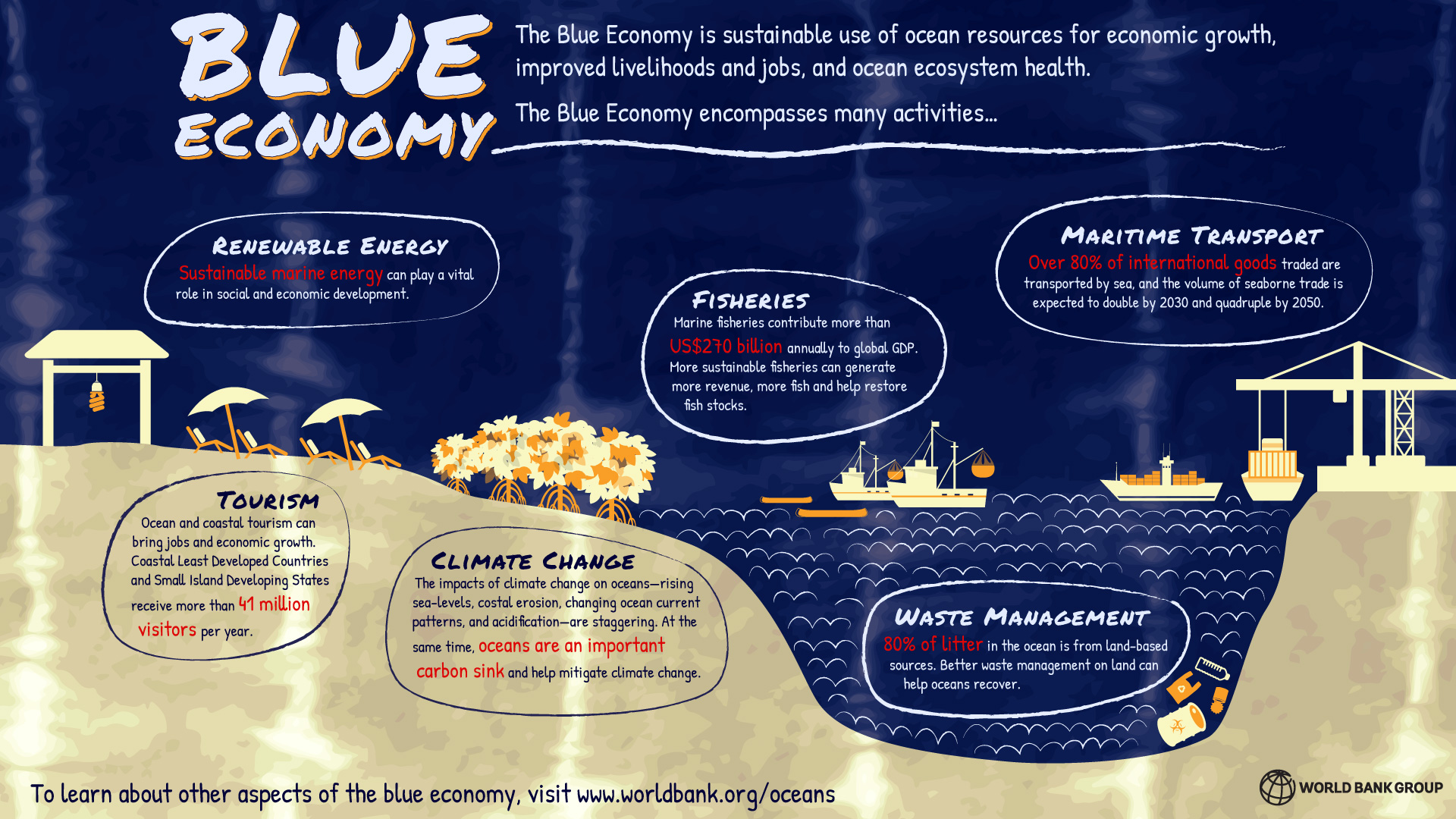
Seawater, marine resources, and the economy around the sea are called the "Blue Economy".
The concept of "Blue Economy" came up at the United Nations Conference on Sustainable Development (Rio + 20) held in Rio de Janeiro, Brazil on June 20-22, 2012.
Analyzing the trends of economic development of different countries, it can be seen that the more efficiently a country has been able to use the sea, the more it has been able to take its economy forward.
Mango The US-Japan lust for the Gulf of Alaska, the activities of world politics over the vast waters of the Mediterranean, or the Persian Gulf are not unknown to the world. The recent exercise of superpowers in the South China Sea has shown the dynamics of geopolitics.Sea experts say South Asian politics will control whoever controls the Bay of Bengal.
Ray In the Bay of Bengal, Bangladesh has about 610 km of coastline from Teknaf in the southeast to Satkhira in the southwest and a coastal area of 1 lakh 17 thousand 613 sq km from the coast, 200 nautical miles of special economic zone EZ, and 3 from Chittagong coast. Sovereignty over all kinds of animal and non-animal resources on the continental shelf. And the vast sea area, along with the geocentric development activities of Bangladesh, the sea-based economic development or blue-economy can open before us a new horizon of development.
The concept of maritime economy and its context

Gunter Paulie is the father of the concept of "Blue Economy". He was the first to mention "Blue Economy" in his book "The Blue Economy 10 years -100 Innovations -100 Million Jobs". The seawater, sea resources, and the economy around the sea are called the "Blue Economy". The concept of "Blue Economy" came up at the UN Conference on Sustainable Development and Earth Summit held in Rio de Janeiro, Brazil on June 20-22, 2012.
Abi The advent of the 1972 United Nations Convention on the Law of the Sea, referred to as the Constitution of the Sea, is a blessing for Bangladesh.
2009 In 2009, the present government took a bold step in initiating legal proceedings against India and Myanmar for final determination of Bangladesh '
Claims of Bangladesh, India, and Myanmar in the sea and the verdict of the tribunal/success of Bangladesh
After a long period of dispute, Bangladesh's maritime border with India and Myanmar was resolved through the legal process.
Myanmar's demand for delimitation of maritime boundaries was settled near the proposed Friendship Line of 197 by a fair combination of Bangladesh and Myanmar's proposed equidistance system. The case was decided by ITLOS (International Tribunal for the Law of the Sea), which is based in Hamburg, Germany. ITLOS announced the verdict of this case on 14 March 2012. As a result of the verdict, Bangladesh's ownership of 1,11,631 sq km of sea area was established. Besides, the ownership of 12 of the 18 gas blocks claimed by Myanmar was confirmed by Bangladesh.
Bangladesh has won a landslide victory in the maritime delimitation case with India. The PCA (Permanent Court of Arbitration) was located in The Hague, Netherlands. The tribunal ruled that 19.46 sq km of the disputed 25,602 sq km sea area had been given to Bangladesh. As a result, the total maritime boundary of Bangladesh stands at one lakh 16 thousand 613 square kilometers. As a result of the verdict, Bangladesh has been able to establish sovereign rights over more than one lakh 16 thousand 613 square kilometers of the territorial sea, 200 nautical miles exclusive economic zone, and all kinds of animal and non-animal resources at the bottom. . . . of the continental shelf up to 354 nautical miles from Chittagong coast.
The global importance of the maritime economy
A) Geo-strategic importance:

60 percent of the world's economy is traded by sea.
The Blue Ocean Economy or 'Blue Sea Economy' or 'Marine Economy' has developed around the sea due to the mineral resources including fish and oil and gas inside the sea. The superpowers are desperate to control this economy and geo-strategy. But in this case, the preparation of Bangladesh is negligible.
Experts War experts say, 'Whoever controls the Bay of Bengal, will control South Asia. For this, the superpowers are making various plans to occupy the Bay of Bengal.
B) The base of mineral resources:
Oil-gas
The bottom of the Bay of Bengal is believed to have huge deposits of minerals, including oil and gas. According to the US Geological Survey, only shallow seas contain eight and a half TCF of gas. This calculation is very old. Conoco-Phillips, a leased company in the 10th and 11th blocks of Sagarbaksh, has reported initial reserves of five TCF of gas in blocks 10 and 11. ConocoPhillips is in talks with the government to lease two more blocks in the deep sea. Besides, Indian company ONGC and Singapore-based company Krish have been given one block each.
It is unknown at this time what he will do after leaving the post. However, neighboring India has reported potential reserves of 100 TCF of gas in the Krishna Godavari Basin, according to foreign companies and state-owned ONGC. They have also announced reserves of over 20 TCF in the region. Myanmar has also discovered large gas reserves near the border with Bangladesh. For this reason, it is thought that Bangladesh may have large gas reserves in the occupied seas.
Heavy minerals
Not only gas, but 13 types of heavy minerals have also been found in the Bay of Bengal. Eight of them are very valuable, including ilmenite, titanium oxide, rutile, zircon, garnet, cobalt, etc. If these valuable resources can be extracted in the right way, it is possible to earn thousands of crores of foreign currency.
C) Possibility of sea transport:
Through Chittagong and Mongla seaports of Bangladesh, import and export of 26 billion US dollars are done every year through about 2600 ships in different countries of the world. Ship rental for these products is six billion dollars a year. Of these, only 36 are Bangladeshi ships. Last year this number was 70. Where the number of domestic ships is supposed to increase, it has not. However, importing and exporting goods on the country's ships will not only capture the huge market of six billion dollars but will also reduce the cost of transporting goods. With the development of this sector, the shipping agency, freight forwarding, the bank-insurance sector will be developed so that new types of employment will also increase. However, as the construction of deep seaports has stalled, the huge potential of this sector of freight transport is not being revealed at the moment.
D) Shipbuilding and shipbreaking industry
Bangladesh is ahead of others in the shipbreaking industry. New ships are also being built in the country now. Bangladesh ranks 13th in Asia in the shipbuilding industry. And Bangladesh ranks third in the world in the shipbreaking industry. 24.6% of the world's total shipwrecks are carried out in Bangladesh. Various government departments have said that the long coastal areas of the country, especially the coastal areas of Chittagong and Cox's Bazar, could make a significant contribution to the national economy if utilized for this industry.
E) Extraction of fishery resources:
800 million metric tons of fish are being caught in the Bay of Bengal every year. There are 435 species of fish in the sea. It is possible to earn a lot of foreign currency by catching fish through advanced fishing trawlers.
F) Search for unknown assets
In addition to oil, gas, and mineral resources, the seafloor is considered as a reservoir of various kinds of known and unknown resources. The sea contains phosphorite, evaporite, polymetallic sulfide, manganese nodules, gas hydrate, magnesium, and salt. According to the sources, more than half of the magnesium in the world comes from the sea. It is also possible to get renewable energy from the sea. This includes wind, waves, and currents to generate electricity. In addition, marine therapeutics are available in the sea which is used to make drugs. There are 10,000 compounds of this type of drug available from the sea all over the world. There is no research or survey in Bangladesh about this. In addition to all this, salt can be produced from the sea using modern advanced technology, which can be exported abroad by meeting the needs of the country.
G) Increase in capital flows;
H) There will be infrastructural development;
I) Unemployment will decrease;
J) Social and economic inequality will be eliminated;
K) Bangladesh's role in the international arena will increase.
Goals:
In this context, Rear Admiral (Retd.) Md. Khurshed Alam, Secretary of the Maritime Unit of the Ministry of External Affairs, who is known as the hero of sea conquest, told Kaler Kanth, 'Technology is needed to extract marine resources. Along with that, there is a need for research and study. But the sea has never been researched and studied in Bangladesh before. There is no sophisticated technology in fish extraction and extraction of mineral resources.
There are 435 species of fish in the sea. But now our country's boats and ships can go only 20 to 50 kilometers to catch fish. We have to develop technology as well as build ships to extract marine resources. Research and survey should be done at the same time.
Mohammad Noor Mohammad, a marine researcher, said, “The major land resources will gradually run out. The sea will be the only hope. This seems to have brought Myanmar to perception, but Bangladesh is silent on all issues except the tension over the allocation of oil and gas blocks at sea. "We have a lot of property at sea," he said. At the moment it is necessary to survey the marine resources and find out what resources are there. Then decide how to use this resource. He also said that in order to use the accounting of resources, 'oceanography' is needed, which we have to develop.
I nitiative to develop tourism industry:
At present, the number of tourists worldwide is about 900 million. It is estimated that by 2020 this number will stand at 160 crores. According to tourism experts, about 63 percent of this huge number of tourists will travel to Asian countries. According to the World Tourism Organization, the industry will employ 296 million people by 2018, contributing 10.5 percent to the world economy.
Mining of mineral resources:
The bottom of the Bay of Bengal is believed to have huge deposits of minerals, including oil and gas. According to the US Geological Survey, only shallow seas contain eight and a half TCF of gas.
It is unknown at this time what he will do after leaving the post. However, neighboring India has reported potential reserves of 100 TCF of gas in the Krishna Godavari Basin, according to foreign companies and state-owned ONGC. They have also announced reserves of over 20 TCF in the region.
Not only gas but 13 types of heavy minerals have also been found in the Bay of Bengal. Eight of them are very valuable, including ilmenite, titanium oxide, rutile, zircon, garnet, cobalt, etc. If these valuable resources can be extracted in the right way, it is possible to earn thousands of crores of foreign currency.
Increase in the number of ships for sea transport
Through Chittagong and Mongla seaports of Bangladesh, import and export of 26 billion US dollars are done every year through about 2600 ships in different countries of the world. Ship rental for these products is 6 billion a year. Of these, only 36 are Bangladeshi ships. Last year this number was 70. To increase the number of ships for sea transport.
Shipbuilding and shipbreaking industries
Comparison and evaluation of Bangladesh's position in the context of other countries
With little access to fisheries
Thailand harvests 86 billion worth of fish from the sea each year. Six lakh fishermen of the country are directly involved in this work. Compared to that, the rate of fishing from the sea in Bangladesh is negligible. Thai fishermen procure fish from the waters of Bangladesh through advanced fishing trawlers. 800 million metric tons of fish are being caught in the Bay of Bengal every year. Of this, only 0.70 million metric tons of fish are caught by the fishermen of our country. In other words, the fishermen of Bangladesh are not able to catch even 1 percent of the huge fishery resources of the Bay of Bengal only due to the lack of advanced ships and technology. Fishermen of Bangladesh are not able to catch even 1 percent of the fishery resources due to a lack of advanced ships and technology. Again, Bangladesh does not have a survey on what kind of fish are in any part of the Bay of Bengal. As a result, fishermen go fishing through their experience.
• It is known that the fishermen of Bangladesh fish within 30 km of the shallow sea by small boats. 3 million fishermen are involved in fishing in the Bay of Bengal through about 80,000 small trawlers. Due to the lack of large fishing vessels (industrial fishing trawlers), Bangladesh is not able to earn any income from the deep-sea fish resources within and outside 200 nautical miles.
• It is not only possible to earn billions of dollars from sea fish, but it is also possible to export fish food abroad. It is possible to make different types of medicines, sauces, chitosan from fish food, fish oil. These expensive products can also be exported abroad.
No initiative in the development of tourism
At present, the number of tourists worldwide is about 900 million. It is estimated that by 2020 this number will stand at 160 crores. According to tourism experts, about 63 percent of this huge number of tourists will travel to Asian countries. According to the World Tourism Organization, the industry will employ 296 million people by 2018, contributing 10.5 percent to the world economy. But Bangladesh has little preparation in this sector. Based on the direct contribution of the tourism industry to GDP, Bangladesh's tourism industry ranks 142nd out of 17 countries. According to the World Tourism Organization, the number of annual tourists in other South Asian countries is much higher than in Bangladesh.
But Bangladesh has the longest beach in the world of 120 km - Cox's Bazar. If we can build a tourism industry around this beach, the whole of Bangladesh can change. Making Cox's Bazar and Coral Island Centrumton attractive for international tourists will attract a large number of foreign tourists to the region. However, in the four and a half decades after independence, Cox's Bazar has not developed suitable facilities for foreign tourists.
Mohammad Noor Mohammad, a marine researcher, said, “The major land resources will gradually run out. The sea will be the only hope. This seems to have brought Myanmar to perception, but Bangladesh is silent on all issues except the tension over the allocation of oil and gas blocks at sea. "We have a lot of property at sea," he said. At the moment it is necessary to survey the marine resources and find out what resources are there. Then decide how to use this resource. He also said that in order to use the accounting of resources, 'oceanography' is needed, which we have to develop.
Government steps to implement Blue Economy:
A) The work of Pigeon Sea Port is progressing at a fast pace
One of the projects included in the Prime Minister's priority project is the Pigeon Deep Sea Port. The work of implementing this mega project is moving forward at a fast pace. The government has identified 19 components (levels) proposed for the implementation of the Pigeon Port construction project. On this basis, the Ministry of Shipping has formed a 7-member committee to select various countries and companies interested in this 19 percent or level. This information is known from the sources of the Ministry of Shipping.
According to ministry sources, 24 companies from the United States, the United Kingdom, Germany, France, Belgium, the Netherlands, Italy, India, China, and Japan have already expressed interest in pigeons. However, Chinese companies are most interested in. Three Chinese companies are reportedly showing interest in pigeons.
And HR Wallingford, a UK-based consulting firm, has designed a portion of Pigeon Port in the style of Rotterdam Port. The world-famous port of Rotterdam in the Netherlands is touching the seaport of Pigeon, said Capt. Saidur Rahman, Acting Chairman of Pigeon Port Authority.
Research Oceanography to study the following subjects, viz.
1. Physical Oceanography;
2. Geological Oceanography;
3. Chemical Oceanography;
4. Biological Oceanography;
5. Climate Change and the Ocean;
. Any other subject of oceanography.
To undertake and conduct basic and practical research activities related to oceanography, to implement the research findings, and to be responsible for the management, coordination, and control of all related activities;
1. Provide Environmental Impact Assessment Report and Coastal Environmental Monitoring of any project in the coastal area before undertaking any public or private project;
2. Collection, storage, and distribution of research data and results through the establishment of a modern Oceanographic Data Center
3. Reporting on Oil Spill Risk Assessment;
Provide appropriate recommendations for determining and conserving aquatic and aquatic, renewable and non-renewable marine resources through the application of modern science and technology for the establishment of generational justice in the use of marine resources;
Conduct public awareness activities on sea issues including training of skilled manpower through training;
Integrate activities on maritime issues with domestic and international organizations;
Conduct, collaborate and receive and coordinate joint research activities with local and international universities and other research institutes conducting research on marine issues;
Taking Planning of research activities including procurement and maintenance of scientists, research vessels, and other suitable types of equipment required to perform the above functions.
Strategies to achieve goals:
Urgent steps need to be taken to ensure Bangladesh's maritime security in order to implement the benefits of Italos and PCA judgments. Through proper management of these resources, it is possible to expand the fisheries industry. Everything needs to be done for this
* A multifaceted plan is needed to protect the sea region and its environment and sustainable extraction of resources. Multiple ministries and agencies of the government have to implement it. To coordinate and monitor these activities and to form a high-powered maritime commission under the Prime Minister's Office at the national level to formulate and monitor government policies for the protection and development of marine resources.
* To formulate a comprehensive maritime policy and strategy and create a sea vision targeting the year 2050.
* Accurate survey of marine resources on an emergency basis. Ensuring the extraction, use, and maintenance of these resources through the expansion of international trade, long-term energy security, food security, and domestic and foreign investment to achieve the country's economic growth.
* Strengthen the Coast Guard to ensure the safety of navigable merchant ships and to protect the navy and fishermen in the coastal areas to prevent piracy in domestic and foreign ships.
* To preserve the biodiversity and natural environment of the sea and coastal areas and keep the sea free from pollution.
* In addition to rising sea salinity and sea-level rise as a result of global warming, sea pollution is increasing for many reasons, threatening the balance of life, resources, and nature. Identify the source of pollution and deal with it.
* Accelerated launch of Bangabandhu Sheikh Mujibur Rahman Maritime University, established in October 2013 at Anwara, Chittagong with a view to expediting research and study of oceanography and resources.
* Further research and study on oceanography, marine resources, and the environment are required. To build an effective system in the universities for this purpose.
* To expedite the launch of the National Marine Research Institute at Ramu, Cox's Bazar.
* Enhancing bilateral cooperation with Myanmar and India.
Obstacles:
Although the government has taken steps to implement the Blue-Economy, there are still obstacles. Some ministries feel that the kind of facilities needed for a blue-economy is still inadequate. Not only that, but there are also various obstacles. That is why, for Blue-Economy to be effective, on the one hand, there is a need for more allocation in the budget, and on the other hand, there is a need for skilled manpower.
Report A report on Blue-Economy was recently presented. Where the Ministries concerned with the extraction and proper management of marine resources are advised to increase their involvement. The Ministry of Fisheries and Livestock said it did not have any modern vessels to quickly survey the fishery resources in some areas of the sea. Most of their ships have an engine so fishing boats cannot go beyond 35 kilometers. But their place is up to 64 km in the sea. But fishing boats can fish up to 60 km. Bangladesh's neighbors India and Sri Lanka have more ships. They can also fish from the deep sea. In many countries of the world, fishing is done with long lines. Not only that, but fish production is also increased through the aquaculture method. But despite having 465 species of fish in Bangladesh, Longline technology is not used. In addition, the Ministry has not created skilled manpower for extraction and proper management of fishery resources at sea. However, the ministry thinks that it is necessary to introduce honors courses in marine science at the undergraduate level in different universities of the country.
Ministry According to the Ministry of Shipping, in the last financial year, 6 billion US dollars were traded in Bangladesh by sea. And for this, we have to pay 6 billion dollars for the ship. Most of the foreign exchange earned is going abroad as most of the ships are owned by foreigners. Only 3 ships of the Shipping Corporation are currently in operation. Besides, no ship recycling industry has been developed in Mongla and Chittagong seaports. As a result, old ships are not going to be repaired and recycled.
Ministry According to the Ministry of Environment and Forests, the chars that have sprung up near the sea are being reforested by the Ministry of Environment and Forests. As a result, the ownership of that forest went to the forest department. And for this reason, there is no interest among other entrepreneurs at the government level.
Ministry The Ministry of Lands thinks that chars are awakened by riverine silt in areas near the sea. All these char lands need to be used in a planned manner. The Ministry of Civil Aviation and Tourism thinks that there is no sea cruise tourism in the country. However, coastal tourism activities like St. Martin's Island can be taken up.
মন্তব্যসমূহ
একটি মন্তব্য পোস্ট করুন